
PH 150S Reference Tube Phono…how we do it!
The PH 150S https://www.modwright.com/products/ph-150/ is our Reference Tube phono stage. It is high gain, low noise and extremely high performance. Every part of the deisgn, layout and implemenation are key to it success. I will explain how we do it and why it works.
The PH 150S provides 78dB max MC gain, has resistive and capactive loading, gain adjust and stereo/mono control, on-the-fly. It has RCA MM and MC inputs and offers both fully balanced XLR and RCA main outs. The power supply is outboard for low noise and the internal design is fully dual mono.
The PH 150S uses a pair of Russian Sovtek 6C45 single triod tubes and a pair of 6922/6dj8/7308 dual triode tubes. The Power supply is SS rectified, although we have offered tube rectification with the PH 9.0XT https://www.modwright.com/products/ph-9-0-ph-9-0x-ph-9-0xt-tube-phono-stage/, which is based on the 150S, but designed to a lower price point.
The key to any good audio product, is good layout, solid circuit design, and clean implementation.
Looking inside the PH 150S, you will see a layout that embodies form following function https://www.modwright.com/wp-content/uploads/ph150interior-w1000h680.jpg. All signal leads and noisy power leads are run in twisted pairs, perpendicular to each other and routed in space above the circuit boards, to minimize noise and maximize separation.
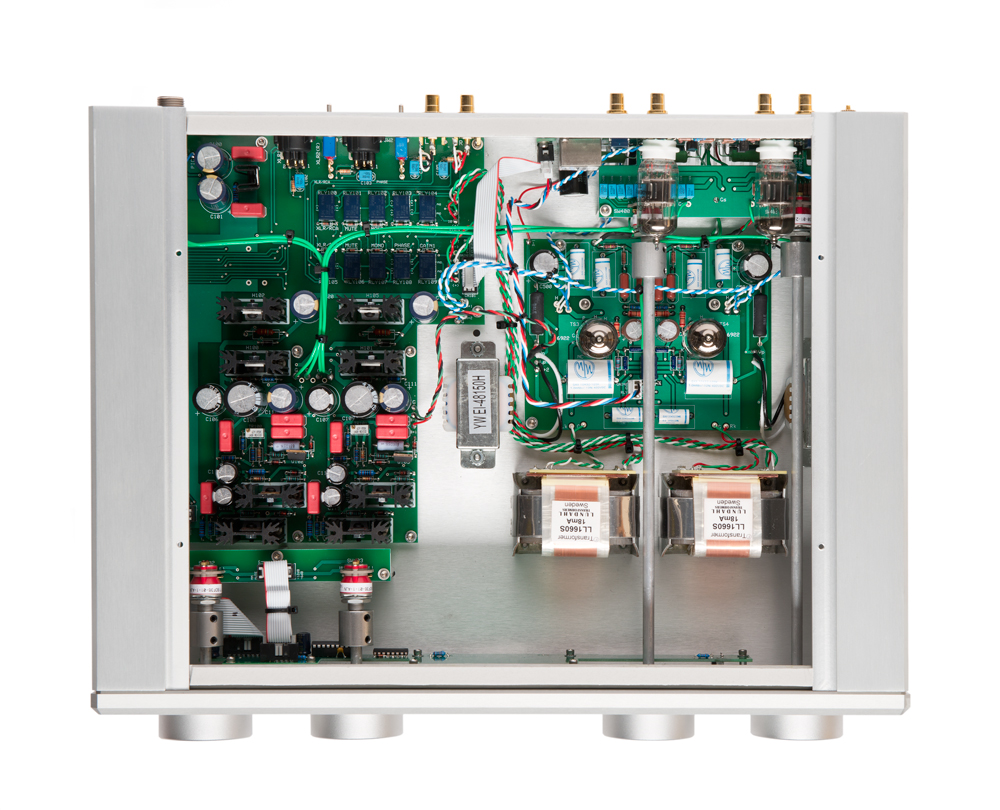
The use of Lundahl step-up transformers, output transformers and anode chokes, all require a very quiet operating environment. These components are sentitive to EMI, generated by all power transformers, chokes and AC noise. For this reason, the use of an outboard supply is required. Additionally, the precise layout and physical orientation of each inductive device is optimized, to minimize noise and interaction.
A short signal path is critical, especially when designing tube phono stages. The RCA’s on the back of the unit are laid out such that the distance from the Right and Left channel inputs are as close to the stepup transformers and first tube gain stage as possible. Signal levels as low as .20mV or lower, are extremely susceptible to noise. Any noise picked up before the first gain stage will be amplified as much as 1000 times, along with the signal.
The PH 150S uses high gain and extremely high performance step up transformer with a gain of 1:8. Cartridge loading is in parallel with the output of the transformer secondary windings, selected by a military spec, gold contact switch, located as close to this circuit as possible.
The signal is then amplified about 1000 times in a circuit comprised of a single 6C45 triode and low noise, matched JFET transistors, for a combined total gain of 60dB from the input RCA to the output of the first stage. Now this means that our .0002V signal is potentially as great as .2V! Now a strong enough signal, to apply the -20dB of RIAA correction to, converting the signal from the grooves of the record, to music.
We still need a second stage to achieve the final gain and a buffer stage, to provide a signal that has a low enough impedance to be transmitted to the preamp or integrated amp to follow, via a potentially long balanced or single ended cable. The dual triode 6922/6dj8/7dj8 tube serves this function, with one inductively loaded triode for gain and the other inductively loaded triode for buffering.
The output of the PH 150S circuit is transformer coupled, meaning there are no coupling capacitors in the signal path. I love the use of inductive coupling (meaning the use of transformers and chokes – or inductors – to transmit signal) because of the special stored energy nature of these circuits and how they allow tubes to truly shine.
The signal is then carried from the output transformer to the output circuit board via teflon insulated twisted pairs, off the circuit boards and carefully routed, for lowest noise and ideal sonic integrity. At the output circuit board, phase, gain, RCA/XL and stereo/mono select are all handled by sealed relays, just adjacent to the RCA and XLR output jacks.
The PH 150S Reference Tube Phono stage is an example of form following function. Each element of the design is hand picked and carefully implemented such that every step of the signal amplification process is kept pure and free of noise. There is a reason that the PH 150S is our Reference and why we based our PH 9.0/X/T series of phono stages on it.
The PH 9.0/X/T phono stages are designed to a lower price point (~$5K less) and yet they retain most of the performance of the Reference PH 150S.
If you are looking for a low noise, high performance phono stage, please consider our PH 9.0/X/T https://www.modwright.com/products/ph-9-0-ph-9-0x-ph-9-0xt-tube-phono-stage/ and PH 150S designs https://www.modwright.com/products/ph-150/.